In the history of Vietnamese lacquer painting, the human figure has always held a central place. From the earliest fine-art son mai works of the 1930s, Vietnamese artists have returned again and again to the figure – particularly the figure of the Vietnamese woman – as a way of exploring identity, beauty, tradition and the passage of time. Among the painters working in this tradition today, Dinh Quan stands out for the elegance and technical mastery he brings to figurative lacquer work.
His paintings of Vietnamese women in traditional ao dai are among the most requested works at Hanoi Art Gallery – sought by Vietnamese collectors who see in them an expression of cultural pride, and by international collectors who are drawn to the combination of classical grace and the extraordinary surface qualities of the son mai medium.
The Ao Dai as Subject
The ao dai – Vietnam's national dress, a long silk tunic worn over wide trousers – is one of the most recognisable garments in the world. Its combination of modesty and elegance, its long flowing lines and the way it moves with the body, have made it a symbol of Vietnamese femininity and cultural identity that has endured through colonial rule, war, modernisation and globalisation.
In Dinh Quan's paintings, the ao dai is never simply a costume. It is the architecture of the composition – the long vertical lines of the tunic creating a natural structural rhythm that works beautifully with the rectangular format of a lacquer panel. The folds of the fabric become an opportunity to explore how lacquer handles subtle tonal gradation – shifting from deep colour in the shadows to luminous highlights at the edges.
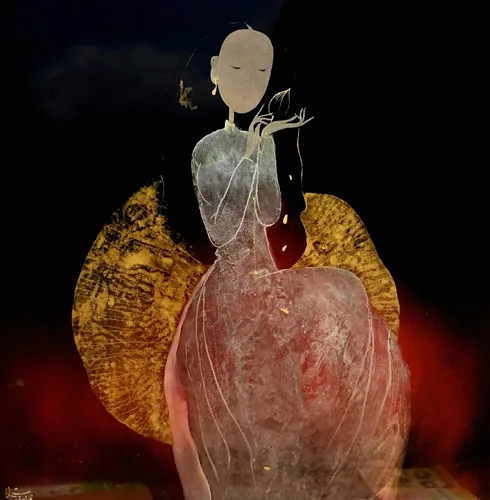
His most celebrated work in our collection, "Charming Lady," exemplifies this approach. The figure is composed with the stillness and confidence of classical portraiture, but the treatment of the ao dai – the layering of lacquer to suggest the translucency of silk, the use of gold leaf at the edges – is entirely contemporary in its technical ambition.
Technical Approach
Figurative lacquer painting presents specific technical challenges that distinguish it from landscape work. The human face, in particular, requires a precision and subtlety that the lacquer medium does not readily offer – unlike oil paint, you cannot adjust a lacquer surface freely once it has been applied. Every mark is a commitment.
Dinh Quan has spent decades developing a technical vocabulary for the face in lacquer – how to suggest skin tone through layered transparent washes of colour, how to use eggshell for the whites of the eyes, how to achieve the particular quality of light on a cheekbone. His faces have a warmth and individuality that is rare in lacquer work, where figures can easily become decorative types rather than felt presences.
The backgrounds in his paintings are typically deep and unified – rich blacks or dark reds that throw the figure forward and give the composition a clarity and impact immediately readable across a room. This formal approach – luminous figure against deep ground – connects his work to classical lacquer traditions while remaining entirely his own.
Works in the Collection
Charming Lady: The most iconic of Dinh Quan's works in our collection. A three-quarter portrait of a Vietnamese woman in white ao dai, her posture composed and assured. The white of the garment is achieved through a combination of eggshell and pale lacquer layers, polished to a surface that suggests silk without imitating it. Against the deep red ground, the effect is one of extraordinary visual clarity.
Lady in White: A more recent work, slightly more intimate in scale. The figure here is shown in a moment of stillness – not posed for the viewer but absorbed in her own thought. The ao dai is blue-grey, a more unusual palette choice that gives the work a reflective, quiet character different from the warmer tones of "Charming Lady."
Portrait Series: Dinh Quan also produces smaller-format portrait studies that are more accessible price points for first-time collectors. These works share the same technical approach as his major pieces but focus more tightly on the face and upper figure.
Who Collects Dinh Quan
Dinh Quan's figurative works attract a broad range of collectors. Among Vietnamese buyers, his paintings are popular as significant family gifts – works that celebrate Vietnamese femininity and cultural tradition in a form that will be treasured across generations. Among international collectors, his paintings appeal to those who come to Vietnamese art through an interest in portraiture and figurative painting generally.
His works are particularly popular with collectors from France, where the combination of Vietnamese cultural subject matter and a classical compositional approach resonates with the French academic painting tradition.
Collecting His Work
- Every work comes with a signed Certificate of Authenticity
- Major works are available by appointment – contact us to arrange a private viewing
- Commissions are accepted: Dinh Quan will paint portraits on commission for collectors who want a specific subject or format
- International shipping via FedEx with full insurance
View Available Works
36-38 Trang Tien Street, Hanoi | hanoiart36@gmail.com | WhatsApp/Zalo: +84 984 589 999