Lam Manh: Abstract Expression in Vietnamese Lacquer Art
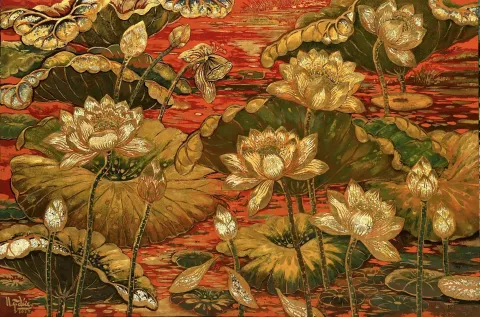
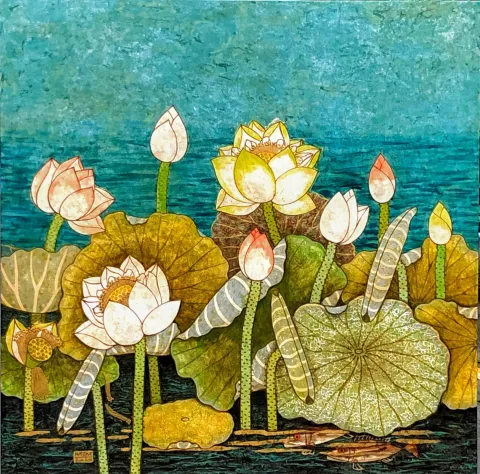
Vietnamese lacquer painting is often associated with traditional subjects – lotus flowers, village scenes, portraits of women in áo dài. Lam Manh takes the same ancient medium and drives it somewhere unexpected: into abstraction, where color, texture, and the physical qualities of lacquer itself become the subject.
With 15 paintings currently represented at Hanoi Art Gallery, Lam Manh occupies an important position in Vietnam's contemporary art landscape. His work appeals to collectors who love the richness and depth of Vietnamese lacquer but want something that speaks the visual language of international contemporary art – pieces that would feel at home in a gallery in London, New York, or Tokyo as much as in Hanoi.
Between Tradition and Experiment
What makes Lam Manh's work distinctive is the tension between ancient technique and modern vision. The son mai process he uses is the same one Vietnamese artisans have practiced for centuries: layers of natural lacquer resin, pigment, eggshell, and metallic leaf, built up slowly and then sanded back to reveal hidden depths. But where traditional lacquer painters use this process to depict recognizable subjects, Manh uses it to explore form, rhythm, and the material's own expressive possibilities.
His abstract compositions often suggest landscapes or natural forces without depicting them literally – the curve of a river seen from above, the fracture pattern of dried earth, the layered geology of a cliff face. The viewer finds meaning through texture and association rather than representation. Gold leaf catches light in unexpected patterns. Eggshell fragments create constellations of white against deep black or burgundy backgrounds. The sanded surface reveals archaeological layers of color that suggest time and depth.
The Language of Abstraction in Lacquer
What sets abstract lacquer apart from abstract painting in oil or acrylic is the element of discovery. In conventional abstract painting, the artist applies paint and the result is immediately visible. In lacquer, the artist builds layers blind – each coat of resin, pigment, or leaf obscures what came before. The image only emerges during the sanding process, when the artist selectively removes material to reveal the buried colors beneath.
This means that a Lam Manh painting is a collaboration between intention and surprise. He plans his layers carefully, knowing from experience which combinations of pigment and leaf will produce certain effects. But the sanding always reveals something he did not fully anticipate – a streak of gold where he expected brown, a depth of blue that seems to recede into the board itself, an interaction between eggshell and resin that creates a texture no brush could produce.
The result is art that feels both controlled and alive – compositions that possess the rigor of design and the organic unpredictability of nature. This duality is what gives Manh's work its distinctive character and why it resonates with collectors who appreciate both craftsmanship and creative risk.
Abstract Art for Modern Interiors
Lam Manh's paintings are particularly sought after for contemporary interior design. Their abstract nature means they complement any decor without competing with it. The natural depth of the lacquer surface – something no print or digital reproduction can capture – adds a quality of contemplative presence to a room that flat canvas paintings rarely achieve.
Interior designers working on hotels, corporate offices, and high-end residential projects in Vietnam and internationally have increasingly turned to abstract lacquer as a way to bring cultural authenticity into modern spaces. A Lam Manh painting on a clean white wall or above a minimalist console becomes a focal point that is simultaneously Vietnamese and universal.
The paintings also possess a quality that designers value highly: they change with the light. Morning sunlight reveals different layers and colors than evening lamplight. The gold leaf catches and releases light as viewers move through a room. This means the painting is never static – it is a living element of the space, shifting subtly throughout the day.
Why Abstract Vietnamese Lacquer is Gaining Attention
The international art market has shown growing interest in Vietnamese contemporary art over the past decade. While figurative and landscape lacquer paintings have long been collected, abstract lacquer is a newer category that appeals to a broader, more design-savvy audience. Collectors who might not connect with a traditional Vietnamese landscape find themselves drawn to abstract lacquer for its material beauty, tactile depth, and contemporary sensibility.
For collectors building a Vietnamese art collection, Lam Manh represents an important dimension. His work demonstrates that son mai is not a historical curiosity but a living, evolving medium capable of expressing the full range of contemporary artistic vision. Owning a Lam Manh painting is owning a piece of that evolution.
Lacquer vs. Other Abstract Media
Collectors sometimes ask how abstract lacquer compares to abstract painting in other media. The differences are significant:
Depth: A lacquer painting has genuine physical depth – twenty or more layers of material built up over weeks. An oil or acrylic painting, however thickly applied, sits on the surface of its canvas. This depth gives lacquer abstracts a three-dimensional quality that photographs cannot fully convey.
Surface: The polished lacquer surface has a luminous, almost liquid quality – somewhere between glass and silk. It invites touch in a way that canvas does not. This tactile dimension is one reason lacquer paintings are so effective in physical spaces.
Durability: Lacquer is one of the most durable art materials known. Vietnamese lacquer paintings from the early 20th century remain in excellent condition. A Lam Manh painting, properly cared for, will outlast oil paintings of the same era.
Uniqueness: The sanding-and-revelation process means that no two lacquer paintings can ever be identical, even if the artist attempts to repeat a composition. Each sanding reveals different layers in different ways.
Available at Hanoi Art Gallery
Browse Lam Manh's collection of 15 original lacquer paintings at Hanoi Art Gallery, 36-38 Trang Tien Street, Hanoi, or online at hanoi-artgallery.com. Every work is an authenticated original with an artist-signed Certificate of Authenticity. Worldwide shipping via FedEx with full insurance.
Commissions welcome – if you are looking for an abstract lacquer piece in a specific size or color palette for your home, office, or hospitality project, the gallery team will coordinate directly with the artist. Contact hanoiart36@gmail.com or WhatsApp +84 984 589 999.